Technical Gases Supply
He
[Helium]
[Helium]
Ar
[Argon]
[Argon]
N
[Nitrogen]
[Nitrogen]
C2H2
[Acetylene]
[Acetylene]
N2O
[Nitrous oxide]
[Nitrous oxide]
О2
[Оxygen]
[Оxygen]
CO2
[Carbon dioxide]
[Carbon dioxide]
Н2
[Hydrogen]
[Hydrogen]
MIX
[Gas mixtures]
[Gas mixtures]
Helium [He]
HELIUM
Helium is a noble gas with the chemical symbol He in the periodic table. It is colorless, non-toxic, inert, odorless and has no taste. Its boiling and melting points are the lowest of all chemical elements and it is the second lightest and most widespread chemical element in the observable universe after hydrogen. On Earth it has evaporated due to its low density. As a result this element is relatively rare, accounting for only 0.00052% of the volume of the atmosphere. Helium is used in cryogenics, various industrial processes for maintaining high pressures, for welding, as a lifting gas in balloons and airships, for generating low temperatures, for creating an inert environment for autogenic metalworking and in electronics, medicine, diving, etc.
Available levels of purity:
- Helium 4.6 (purity 99.996%)
- Helium 5.0 (purity 99.999%)
Helium delivery method:
- Helium pressure cylinders: Volume 50 liter (9.1 m³) at a pressure of 200 (bar).
Balloon gas
Are you organizing a major event or a private party at home? Balloons filled with atmospheric balloon gas brighten up all your events.
Helium - general uses
Electric arc welding
- Inflating balloons
- Leak testing
- Environmental cooling in reactors
- Cooling and fiberglass production
- Chromatography carrier gas
Safety measures
Helium is a non-toxic gas. It is non-combustible non-explosive and, as it is very light, it can easily leak out of closed containers.
No special safety measures are required except for compliance with the standards applied to high-pressure gas cylinders.
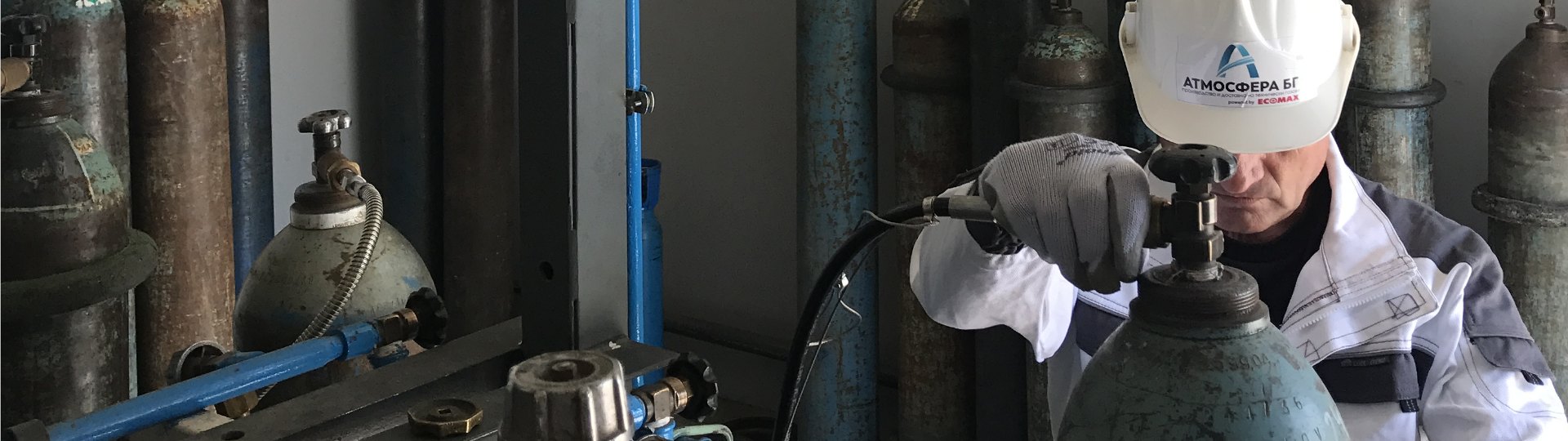
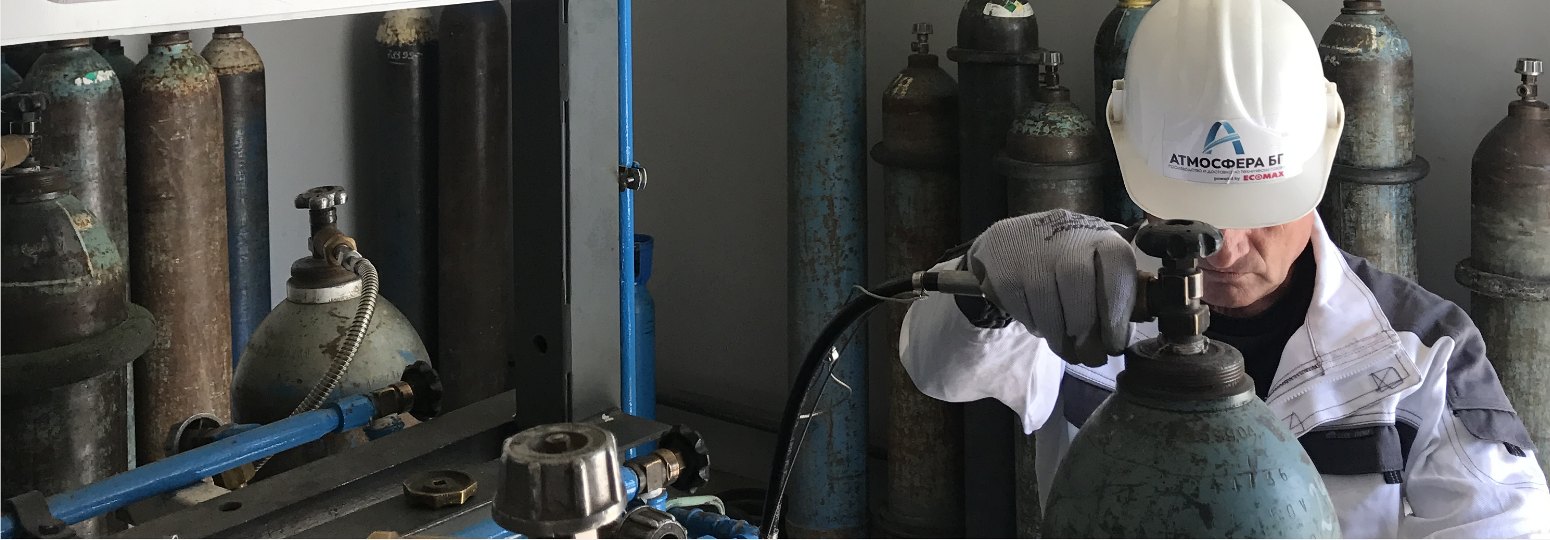
The company has two of its own up-to-date warehouse/production facilities in the country with a full range of infrastructural and technical equipment for filling and storing technical gases in pressure vessels.
The company offers the whole range of technical gases in vessels of various volumes, along with accompanying equipment and consumables for cutting and welding.
The company supplies the following in special vessels: oxygen, nitrogen, argon, carbon dioxide and dry ice, hydrogen, acetylene, helium, nitrous oxide and all kinds of gas mixtures produced in accordance with your individual requirements.
Filling points for oxygen and carbon dioxide, along with equipment for the production of dry ice pellets and blocks, can be found in the following localities: Varna and Shumen
Atmosphera BG delivers O2, CO2 and all other technical gases to customer sites in the following regions: Varna, Shumen, Dobrich, Razgrad, Targovishte, Ruse and Silistra. If you order larger quantities and/or sign a subscription contract, we deliver gases in pressure vessels throughout Bulgaria.
Argon [Ar]
Argon is a noble gas which is colorless, non-toxic, odorless and has no taste. It is an exceptionally stable element with the chemical symbol Ar. It is inert at almost any temperature and does not form any precisely defined stable compounds at room temperature. Argon accounts for 0.934% of the atmosphere by volume. Argon is used in metallurgy, electronics, as a shielding environment in MIG and WIG welding, in electrical, electro-luminescent and gas-filled lamps, in laser production, cryosurgery, wine making and in museums for preserving important documents and objects from aging and other uses.
Degree of purity of argon:
- Argon 4.6. (purity: ≥ 99.998%)
- Argon 5.0. (purity: ≥ 99.999%)
Argon supply options
Argon cylinders and bundles: we offer argon in different cylinder sizes:
- Cylinder volume: 8, 10, 40 and 50 liters;
- Bundles: 12 bundles of 50 liter argon cylinders connected together;
Argon - general uses
- MIG and TIG welding
- Plasma cutting
- Welding and cutting ferrous and non-ferrous metals
Argon is inert at almost any temperature and does not form any precisely defined stable compounds at room temperature. It accounts for 0.934% of the Earth’s atmosphere by volume.
АРГОН
Аргонът е благороден газ, без цвят, миризма, вкус, не е отровен и е изключително стабилен елемент, означаван с Ar. Той е инертен при почти всяка температура и не образува точно определени стабилни съединения при стайна температура. Аргона заем 0,934 об.% от въздуха. Аргонът се прилага в металургията, електрониката, като защитна среда при MIG и WIG заваряване, за електрически, електролуминисцентни и газонапълнени лампи, в направата на лазери, в криохирургията, във винопроизводството, в музеите за запазване на важни документи и предмети от стареене и други.
Степен на чистота на аргон:
- Argon 4.6. (чистота : ≥ 99,998%)
- Argon 5.0. (чистота : ≥ 99,999%)
Опции за доставка с аргон
Бутилки(цилиндри) с аргон и бюндели – предлагаме аргон в различни цилиндри:
Обем на цилиндъра: 8l; 10l; 40l; 50l;
Бюндели: 12 взаимосвързани 50 л аргонови цилиндри;
Аргон - общи приложения
- MIG и TIG процеси на заваряване
- Плазмено рязане
- Заваряване и рязане на черни и цветни материали
Nitrogen [N]
Nitrogen is a chemical element: a colorless gas with the chemical symbol N. It occurs in all living organisms, dead organic matter, seas and oceans and occurs in the composition of proteins, amino acids, nucleic acids, chlorophyll, hemoglobin and elsewhere. Nitrogen makes up most of the Earth’s atmosphere, accounting for 78.084% by volume. It can be obtained by gradually evaporating liquid air and is used to produce ammonia, nitric acid, nitrogen fertilizers and explosives. Nitrogen is used in the food processing, military, electronics and electrical measurement industries, livestock farming, artificial fertilizer production, heat treatment of metals and alloys, welding, tank purging and inerting and other uses.
Nitrogen - purity:
- Nitrogen 4.7 (purity ≥ 99.999%)
- Nitrogen 5.0 (purity ≥ 99.9999%)
- Nitrogen for СО lasers - (purity ≥ 99.999%)
Nitrogen - supply procedures
We supply nitrogen in cylinders:
- 8, 10, 20 and 40 liter nitrogen cylinders: contain respectively: 1, 1.5, 3.0, 6.0 m³ at a pressure of 150 bars
- 50 liters containing 10.0 m³ at a pressure of 200 bars
Nitrogen - general uses
- Protection, inerting and purging
- Nitrogen is used to maintain a dry inert atmosphere above chemicals during storage, reaction or processing
- Food processing industry
- Nitrogen is used for freezing food and cooling and packaging in a modified atmosphere, food storage (controlled atmosphere) and inerting food products
- Metals
- Nitrogen is used in the iron and steel industry
- Lasers
- Nitrogen is used as an auxiliary gas for laser cutting of stainless steel, aluminum and non-metallic materials
- Sample preservation
- Nitrogen is used to safely preserve medical or research samples such as blood, plasma, etc.
Use of Nitrogen (extended):
- Purging and inerting reactors and tanks;
- protecting and transporting oxygen-sensitive substances;
- Temperature control and cooling of food and chemical reactions;
- chemical industry;
- stripping gases from fluid solutions;
- heat treatment of metals;
- steel mixing;
- aluminum de-gassing;
- cold shrink fitting and extrusion;
- solvent condensation;
- compressed gas in plastic production;
- freezing;
- packaging food products in a changeable environment;
- synthetic fiber production;
- welding printing plates;
- semiconductor production;
- backside welding protection, etc.
Acetylene [C2H2]
Acetylene is a hydrocarbon and is the most unsaturated alkene, a colorless, odorless gas, slightly water-soluble and slightly lighter than air. Its chemical formula is C2H2. Acetylene is used in mixtures for gas cutting and welding. It is used in so-called acetylene burners (oxy-acetylene cutters). It gives off a large amount of energy when it burns, reaching temperatures of up to 3,000°C at which steel melts. Acetylene is a common raw material in the chemical industry.
Purity:
we supply acetylene gas with purity ≥ 99.8%.
Supply options:
We supply the following cylinders: 10, 40 and 50 liter cylinders
General uses
- This is the most efficient combustible gas
Acetylene saves time and money - Flexible use with oxygen or compressed air
- Improved cutting quality
Its unique properties enable high-speed cutting and starting high-speed cuts - This is the only gas that burns hot enough to weld steel
- It is the only combustible gas that can be recommended for use in underground working conditions
Nitrous oxide [N2O]
Nitrous oxide, commonly known as laughing gas, is a chemical compound with the formula N2O and is a colorless, non-combustible gas with a pleasant, slightly sweet odour and taste. It causes a feeling of euphoria when inhaled. This gas is used in surgery and dentistry, in the food industry, as an oxidizing agent in rocket engines and in internal combustion engines, increasing their power when added to the fuel (nitro).
Purity and packaged quantities:
Information available on request
Оxygen [О2]
Oxygen is a colorless, odorless gas with no taste. Its chemical symbol is O and it is the most widespread element on Earth, occurring as two allotropes: oxygen and ozone. Oxygen occurs in highly organic substances, in all living cells and in large numbers of inorganic compounds. It forms blue crystals when cooled to -183°C. Oxygen is water-soluble. The lower the water temperature, the more soluble the oxygen. It enables burning, although oxygen itself is non-combustible. Oxygen accounts for a total of 21% of the atmosphere, i.e. in third place after hydrogen and helium. Liquid oxygen is attracted by magnets in laboratory conditions. Almost all of its reactions with other chemical compounds result in heat emission. As a technical gas, oxygen is useful for its reactivity. It is used in the food processing and mining industries, metallurgy, the chemical industry, ecology, health care, etc.
Oxygen is supplied in different volumes and levels of purity for various uses, including welding, burning, oxidization and for life-support.
Oxygen - purity
- Purity ≥ 99.7%
- Medical oxygen
Oxygen delivery method
Oxygen pressure cylinders:
- 10 liter cylinder volume: Contains 1.6 m³ at a pressure of 150 bars;
- 20 liter cylinder volume: Contains 3.2 m³ at a pressure of 150 bars;
- 40 liter cylinder volume: Contains 6.4 m³ at a pressure of 150 bars;
- 50 liter cylinder volume: Contains 7.9 m³ at a pressure of 150 bars;
- 50 L cylinder volume: Contains 10.5 m³ at a pressure of 200 bars
- bundles: Twelve 50-liter oxygen cylinders connected together with an operating pressure of 200 bars and containing 126 m³;
- Liquid oxygen: Oxygen is supplied by means of cryogenic eurocylinders in vacuum-insulated storage vessels (180 liters), which usually provide enough to operate for several days, together with the accompanying evaporation equipment.
Use:
- welding and cutting;
- air enrichment in the production of: glass, slag glass, fiberglass wool, cement, dolomite, lime, fire-resistant materials;
- oxygen blow torches for melting glass;
- chemical industry;
- biological and chemical wastewater treatment;
- ozone production;
- oxygen blow torches in electric furnaces and rotary furnaces for melting lead, copper, aluminum, gold and silver, tin, cast iron and steel;
- Medical gas for breathing (FU), etc.
Carbon dioxide [CO2]
CARBON DIOXIDE
Carbon dioxide is a chemical compound with a molecule comprising one carbon atom and two oxygen atoms: CO2. It is a colorless, odorless gas with a density 1.65 times higher than air. Its concentration in the air varies from 0.03% and 0.06% from one region to another. At a temperature lower than -78°C, carbon dioxide changes its physical state from gaseous to solid: “dry ice”. Carbon dioxide is water-soluble, producing carbonic acid (H2CO3) and back to CO2. This process is referred to as gassing and the product is carbonated water. Liquid carbon dioxide can only be obtained at a pressure exceeding 5.1 bars. Carbon dioxide is used for producing soft drinks, sodium bicarbonate, in fire extinguishers, pharmaceutics, medicine, the arms industry and as a cooling agent in the food processing industry, etc.
СО2 delivery method
Cylinders with the following volumes: 5, 10, 25 and 30 kg;
Dry ice – in pellets or blocks, supplied in expanded polystyrene boxes in volumes as requested by the customer
CO2 - general uses
- food processing industry
- Cooling and freezing foodstuffs, carbonating and dosing drinks, food extraction, packaging for a modified atmosphere
- Welding
- MIG welding of mild steel, welding carbon and alloy steel, shielding gas for plasma cutting
- Water treatment
- Drinking water treatment and wastewater pH testing
- Chemical industry
- Substitute for CFCs in plastic foam production
- Increasing greenhouse productivity and pest control
DRY ICE
Physical properties of dry ice
"Dry ice is the popular name for the solid state of carbon dioxide (СО2). Dry ice is non-combustible, does not contain water and does not conduct electricity.
History
In 1835 the French chemist Charles Thilorier published the first description of dry ice. When opening the lid of a large cylinder full of liquid carbon dioxide, he noticed that the carbon dioxide evaporated quickly, leaving a solid layer of dry ice in the cylinder. In the course of the following 60 years, dry ice was observed and tested by numerous scientists to find out all of its useful properties and possible applications.
Use of dry ice
In practice dry ice has many uses:
Dry ice becomes a gas directly when it melts, absorbing heat in the melting process and thereby reducing the temperature of its surroundings. Thanks to this process dry ice can be used as a cooling agent and, when dry ice is scattered in the upper layer of the atmosphere, water vapor condenses in the air and causes artificial precipitation.
Dry ice can be used for chemical cleaning, successfully removing residues, colloidal substances and oil contamination for example.
Dry ice is used in medicine and cosmetics. Some dermatologists use dry ice to treat acne. This is called cold treatment, because it gently freezes the skin. The frozen material for treating acne is a mixture of crushed dry ice and dimethyl ketone, sometimes with a little added sulfur. It is also used for removing unwanted skin growth. Liquid nitrogen and dry ice can also be used for freeze-treatment, which can reduce wound inflammation.
Dry ice is also used in the food processing industry. When added to wine, cocktails or drinks, it creates an impressive visual effect. Add dry ice when preparing ice cream as an experiment. The ice cream will then be very difficult to melt. Dry ice can also be used as a source of carbon dioxide, including for fizzy water and other liquids such as beer.
When dry ice is placed in water, the sublimation process speeds up, spreading a thick, low-lying, fog. This is used in smoke machines in theaters and nightclubs to produce a mystical-dramatic effect.
Dry ice is also used in large quantities for the refrigerated transport of frozen fruit, vegetables, meat products and seafood. Last but not least, dry ice is used for the transport of special medicines, organs, blood plasma and vaccines.
Dry ice is also extremely useful for cleaning contaminated surfaces without using any chemical products or organic solvents. The contaminated surface is blasted with microscopic dry ice granules which evaporate in the air in a sublimation effect in which the layer of contamination evaporates together with the frozen CO2 granules and simply “disappears” without any damage to the cleaned surface. This process is known as ice blasting
Preparing to work with dry ice and recommendations
Step 1
Preliminary preparation for work with industrial quantities of dry ice
Plan when you will need the dry ice in advance, as you will have to use it as quickly as possible because it changes from its solid to its gaseous form with time. Make sure that the vehicle or the room in which you will work are well-ventilated.
During the process where dry ice turns to gas, it releases carbon dioxide into the air, which could be hazardous when working with large quantities in small and/or tightly enclosed premises, so if you feel any sudden symptoms such as headache, difficulty in breathing, blue lips or fingernails, leave the room and/or ventilate it immediately. Fresh air is essential in this case, as recycled air will not be safe.
Make sure you wear gloves when holding dry ice, as it can cause freezing. Keep an eye on any children who may be in the area and never leave dry ice unsupervised.
Step 2
Choose a suitable container
Store dry ice in a solid insulated container, e.g. made of expanded polystyrene, but remember not to seal the container, as the evaporation of carbon dioxide may cause a pressure increase in the vessel. Keep the container in a well-ventilated room and do not place the dry ice in a freezer or refrigerator, as the thermostat will cut off due to the extremely low temperatures that the dry ice can cause.
Step 3
Work carefully with the dry ice
Wear your gloves, open the dry ice container carefully and then, using your hands or a suitable tool, take the pellets or block of dry ice out of the container and place them on a soft surface such as cloth, a plastic surface or a concrete floor (dry ice may damage hard surfaces covered with tiles, etc., due to its low temperature).
Step 4
Safe disposal
When you are ready to dispose of the dry ice, simply take it out of the insulated container and leave it unpackaged on a soft surface to aerate. This will make it evaporate (sublimate). Make sure in advance that the room is well-ventilated. Ventilate all storage spaces and rooms in which you have stored dry ice, as carbon dioxide is heavier than air and collects in low-lying places in unventilated premises.
Uses of dry ice
Dry ice is ideal coolant for the storage and transport of meat products, fish, fruit and vegetables and delicate products such as cakes and ready-made catering meals. It protects the cooled product and fully prevents food from getting wet or deformed.
Its characteristics make it suitable for use in medicine, to preserve tissues and samples.
Industrial cleaning with dry ice gives excellent results without chemicals or abrasive ingredients, by blasting the solid carbon dioxide onto the surfaces to be cleaned. This method is also used in urban environments to remove stubborn contaminants from building facades and even to erase graffiti.
- storage and transport of frozen or cooled food products
- storage and transport of medical, pharmaceutical, research and other temperature-sensitive materials
- technical cooling agent in the food, chemical, research and pharmaceutical industries
- freezing of live produce
- manufacture of heat-shrinkable items
- Industrial jet cleaning with dry ice
- special effects and fog machines
- cold grinding of food in plastic
- drying of rubber products
- freezing of pipes
Hydrogen [Н2]
HYDROGEN
The only combustible gas that does not contain any carbon atoms. Lighter than air, it burns with an invisible, clean flame (no carbon and no soot)
Hydrogen gas is supplied with varying degrees of purity to meet requirements varying from heat transfer applications to scientific analysis:
- 99.999% hydrogen (5.0)
- 99.9995% hydrogen (5.5)
Hydrogen supply options:
50 liter hydrogen cylinder at a pressure of 200 bar;
Uses:
- Food and Drinks
- Hydrating edible liquid fats, margarine oil and other fats
- Iron and Steel
- TIG and plasma welding and cutting
- Pharmaceutics
- Production of intermediate pharmaceutical products
- Aerospace applications
- Fuel gas for spaceship ignition and for protecting internal spaceship systems
Gas mixtures [MIX]
A / Gas mixtures for the food processing industry: N70; O80
We offer a range of pure gases and gas mixtures specially developed for the food processing industry.
We offer a broad range of dual-component or triple-component gas mixtures with oxygen, carbon dioxide and nitrogen.
Depending on the characteristics of your products, we supply individual gas mixtures in varying percentages of oxygen, carbon dioxide and nitrogen.
We will work together with you to assess the requirements for your process and location in order to develop the most suitable gas mixture for the packaged food.
Get in touch with our experts to find the most suitable gas mixture for your product.
Supply method:
Gas cylinders: Supplied in a variety of cylinder sizes from 10 liters to 50 liters at a pressure of 150 bars;
B / Welding gas mixtures
A range of welding gases and welding gas mixtures from Atmosphera BG can help to optimize welding processes. Find the most suitable gas mixture for your welding process.
Description
Shielding gas mixtures are used in welding to shield the electrode and the welding arc from the surroundings.
The choice of gas mixture should be appropriate to ensure the correct operation of welding machines and a high-quality end product. The choice of shielding gas mainly depends on the following factors:
- welding process – MIG, MAG, WIG, PLASM
- material to be welded
- thickness of the material to be welded
- electrodes
- mechanical characteristics of the weld
- welding speed
- external appearance of the weld
- expenditure, etc.
Argon and CO2 mixtures
Gas mixtures with argon as a basic component: ideal as a shielding gas for MAG welding.
C18: 82% Ar + 18% CO2
- Shielding gas (short arc and spray arc) for MAG welding of non-alloy and low-alloy steel
- Also suitable for electrodes with a welding cable
C8: 92% Ar + 8% CO2
- Shielding gas (short arc and spray arc) for MAG welding of non-alloy and low-alloy steel
- Also suitable for electrodes with a welding cable.
O4: 96% Ar + 4% CO2
Forming gas: nitrogen and hydrogen mixtures
Forming gases are a group of gas mixtures containing hydrogen and nitrogen in various proportions. Forming gases are used to eliminate the need for cleaning after welding with a low level of surface oxidation.
- The following gas mixtures are available:
- Forming gas 5 - 95% nitrogen and 5% hydrogen
- Forming gas 10 - 90% nitrogen and 10% hydrogen
- Forming gas 15 - 85% nitrogen and 15% hydrogen
- Forming gas 20 - 80% nitrogen and 20% hydrogen
Supply procedure:
Forming gases from Atmosphera are available in 40 liter and 50 liter cylinders at a pressure of 150 bars.
Technical gas supply
Filling points for oxygen and carbon dioxide, along with equipment for production of dry ice pellets and blocks, can be found in the following localities: Varna and Shumen
Atmosphera BG delivers O2, CO2 and all other technical gases to customer sites in the following regions: Varna, Shumen, Dobrich, Razgrad, Targovishte, Ruse and Silistra. If you order larger quantities and/or sign a subscription contract, we deliver gases in pressure vessels throughout Bulgaria.
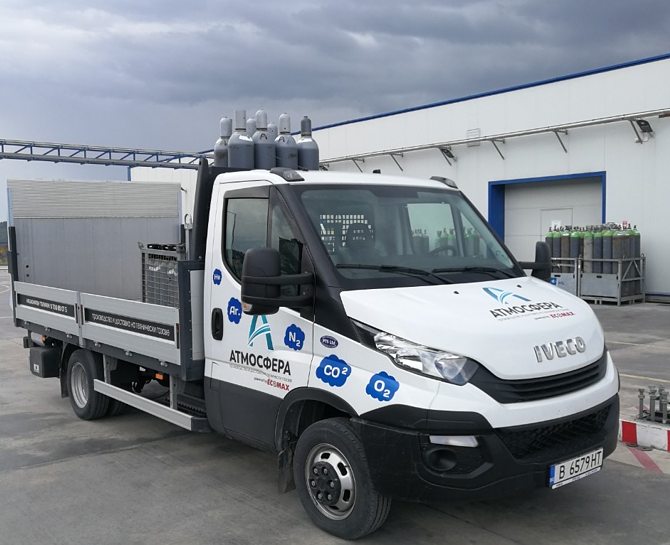
Technical gases Delivery on spot
Filling points for oxygen and carbon dioxide, along with equipment for production of dry ice pellets and blocks, can be found in the following localities: Varna and Shumen
Atmosphera BG delivers O2, CO2 and all other technical gases to customer sites in the following regions: Varna, Shumen, Dobrich, Razgrad, Targovishte, Ruse and Silistra. If you order larger quantities and/or sign a subscription contract, we deliver gases in pressure vessels throughout Bulgaria.